
Pinal County Court dockets display upcoming hearings, trials, and legal proceedings across Superior and Justice Courts. These schedules provide precise hearing times, case classifications, and judicial assignments for parties, attorneys, and stakeholders. Each entry ensures timely preparation and coordination for court appearances, mitigating scheduling conflicts. Daily updates reflect continuances, adjournments, or cancellations, maintaining an accurate procedural record. Comprehensive docket access supports efficient case management and informed legal participation.
Docket listings include detailed information such as case numbers, involved parties, hearing types, and courtroom designations within the Pinal County Court system. Users can monitor civil, criminal, family, or probate matters and adjust preparations accordingly. Court calendars facilitate organisation, track deadlines, and confirm judicial availability in Pinal County Court proceedings. Public terminals and online platforms enhance accessibility, ensuring all parties remain informed. Maintaining awareness of docket updates minimises errors and supports procedural compliance.
What Are Court Dockets in Pinal County?
Court dockets in Pinal County are official schedules of cases set to be heard in the county courts. They provide a detailed listing of case numbers, parties involved, types of hearings, and the assigned judges. A court docket is essentially a record of all proceedings scheduled in a court on a specific day or over a given period. In Pinal County, these docket listings include important details such as:
- Case numbers – unique identifiers assigned to each case
- Names of parties – plaintiffs, defendants, or petitioners
- Hearing types – criminal, civil, family, or traffic matters
- Judge assignment – the judge presiding over the case
- Courtroom location and time – when and where each hearing will occur
These details allow attorneys, litigants, and the public to track daily court schedules efficiently. By reviewing the docket, attorneys can prepare for upcoming hearings, ensure proper filings, and coordinate with clients. For the public, docket listings provide transparency in court operations, making it easier to attend hearings or check the progress of cases.
Why Pinal County Court Dockets Matter
Court dockets are more than just schedules—they are vital for maintaining courtroom ororganisationnd efficiency. Judges rely on these listings to manage multiple cases each day, while court staff uses them to track proceedings and update records.
For legal professionals, case numbers in the docket allow quick access to case files and prior court actions. Attorneys can anticipate conflicts, manage filings, and plan arguments based on the docket’s order of cases. Meanwhile, journalists, researchers, and citizens often consult dockets to stay informed about local legal activity, ensuring transparency and accountability.
How Dockets Reflect Court Activity
Pinal County dockets also serve as a snapshot of court operations.
They indicate:
- The volume of cases scheduled daily
- The types of hearings handled by the court
- Which judges oversee specific case types
Many courts, including Pinal County, make these judge calendars publicly available. This openness helps maintain trust in the judicial system and ensures timely legal processes. For attorneys, knowing the docket allows them to prioritise work and coordinate with opposing counsel efficiently.
Searchable Docket Listings & Case Access
Pinal County court dockets can be searched online using simple public tools that provide clear case listings. These systems help users check filings, court events, and case details quickly and efficiently.
How to Search Court Records
To search court records effectively, users should follow a clear method:
- Start with the official online docket search: Use the Pinal County Clerk of Superior Court website to enter the party name, case number, or attorney.
- Use filters: Narrow results by case type, date range, or court division to locate relevant cases.
- Review case summaries: Check the case status, filing date, and upcoming hearings.
- Check event history: Each listing shows motions, rulings, and court events chronologically.
- Verify details: Make sure the party name and case type match to avoid confusion with similar cases.
Following these steps ensures accurate case lookups and saves time when searching docket listings.
Where to View Pinal County Court Records
Users can access court records through several options:
- Official Online Docket Search (Free)
The primary source is the Pinal County Clerk of Superior Court https://www.azcourts.gov/selfservicecenter/Superior-Court-Clerks-of-the-Court
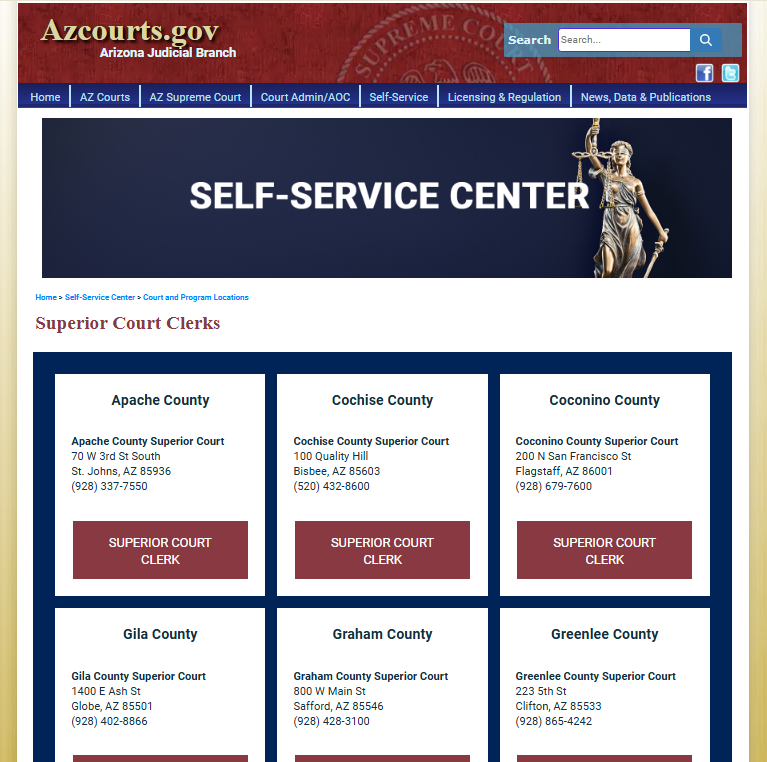
- This provides full docket listings, updates, and links to PDF downloads. Download fees are typically $0.25–$0.50 per page, and certified copies may cost about $2 per page.
- Third-Party Public Record Services (Paid)
Various online services provide case summaries for a small fee, usually $0.99–$5 per report. These reports are convenient but may not include certified copies or full case documents. - In-Person Requests at the Clerk’s Office (Paid)
Residents can visit the Pinal County Courthouse at 971 N. Jason Lopez Circle, Building A, Florence, AZ 85132. In-person requests allow access to full case files, certified documents, and physical copies. Costs range from $0.50–$2 per page, depending on the document type.
By using these methods, users can easily access public records and stay updated on case activity. Knowing the cost and location for each option helps plan both digital and in-person requests efficiently.
How to View Pinal County Court Calendars
Pinal County court calendars can be checked directly through the court’s official website, offering daily updates on scheduled hearings. Users can search by case number, party name, or hearing type to find relevant court dates quickly.
Accessing the Official Court Calendars
The Pinal County Court maintains an online calendar that lists all upcoming hearings for justice, superior, and specialty courts. To access the daily docket:
- Visit the Pinal County Courts website at https://www.pinalcourtsaz.gov/calendar.aspx
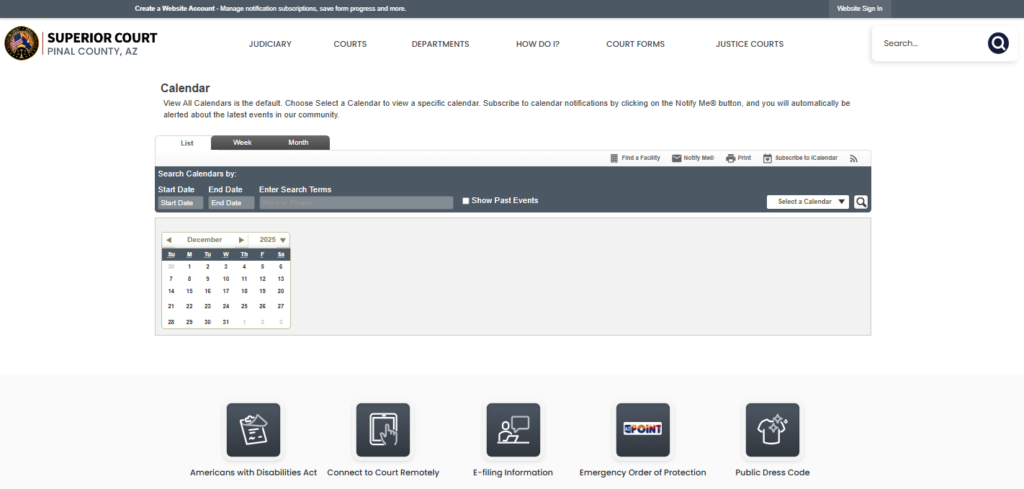
- Click on “Court Calendars” in the menu, usually under the “Online Services” section.
- Select the type of court: Superior Court or Justice Court, depending on the case.
- Choose a date range or specific hearing type for faster results.
- Enter the case number or party name if looking for a specific case.
The online calendar provides a clear list of hearings, including time, courtroom location, judge, and case type. Users can view daily dockets for the current day or upcoming weeks.
Tips for Searching by Case or Party
Searching by case number is the most precise method. Enter the number exactly as provided to see all scheduled hearings and related case details. Searching by party name works best when spelling is accurate. The system will return matches for plaintiffs, defendants, or attorneys associated with the case. Users can also filter results by hearing type, such as criminal, civil, or family court, for faster browsing.
The Different Court Schedules
Pinal County hearing schedules vary depending on the type of court and case. Each court maintains its own calendar for hearings, motions, and trials to ensure cases proceed efficiently.
Courts in Pinal County operate on structured schedules to handle a wide range of cases. Superior Court, Justice Court, and Municipal Court all maintain separate dockets, reflecting the nature and urgency of the matters they oversee. Schedules are organized by day, week, and type of hearing, allowing attorneys, parties, and the public to track upcoming proceedings clearly.
Superior Court Hearing Schedules
Superior Court handles major civil and criminal cases, which means its calendars are divided into criminal vs. civil hearings. Criminal cases often include arraignments, pre-trial motions, and trial dates. Civil cases involve disputes between individuals or organizations, with schedules for motions, status conferences, and trials.
- Motion Hearings: Short sessions for judges to hear requests that do not require a full trial.
- Trial Dates: Fixed dates when the full case is presented, including evidence and witnesses.
- Criminal vs. Civil Calendars: Criminal hearings are often prioritized for public safety matters, while civil cases follow a sequence based on filings and procedural deadlines.
Superior Court schedules are typically updated weekly, allowing lawyers and litigants to prepare adequately. Court clerks can provide printed or online daily and weekly calendars for review.
Justice and Municipal Court Schedules
Justice and Municipal Courts handle smaller cases such as traffic violations, small claims, and evictions. These courts maintain faster-moving calendars to resolve minor disputes efficiently.
- Traffic Cases: Include speeding tickets, license suspensions, and other minor violations.
- Small Claims: Covers monetary disputes typically under a set financial threshold.
- Evictions: Landlord-tenant disputes follow strict statutory timelines.
Schedules for these courts are often available online via the Pinal County court portal. Users can check hearing times, assigned judges, and courtroom locations to plan attendance or legal representation.
Weekly & Daily Dockets
Weekly and daily dockets provide a detailed overview of court activities. A weekly docket lists all scheduled hearings for the week, including times, courtroom numbers, and case types. A daily docket focuses on hearings occurring on a specific day.
- How to Read a Docket:
- Time: When the hearing begins.
- Case Type: Civil, criminal, traffic, small claims, or eviction.
- Parties: Names of the plaintiff and defendant.
- Judge: Assigned judicial officer.
- Courtroom: Location within the courthouse.
Dockets help ensure that parties attend hearings on time and understand which cases are prioritized. They also reflect motion hearings, trial dates, and other procedural events critical to case progress.
Motion Hearings and Trial Dates Explained
Motion hearings and trial dates are specific court events where legal issues and cases are formally addressed. Motion hearings deal with requests made to the court, while trial dates are when the case is fully heard before a judge or jury.
What Motion Hearings Are
A motion hearing is a scheduled session where a judge reviews and decides on formal requests called motions. These motions can ask the court to take action, change a previous decision, or clarify legal questions. The outcomes of these hearings are recorded in Public Records, providing an official reference for the parties involved and the public. During the hearing, attorneys present arguments and submit documents, responding to opposing motions as needed. The judge then makes a decision, which can influence the overall direction of the case.
Key points about motion hearings:
- Typically scheduled after a motion is filed.
- Usually lasts 10–30 minutes but can be longer for complex issues.
- Can be held in person or, in some cases, virtually.
Typical Scheduling Process
Motion hearings and trial dates are scheduled according to the court’s calendar updates and judge schedules. Once a motion is filed, the clerk’s office sets a hearing date, often providing notice to all involved parties. Trial dates are usually set after pretrial procedures, such as motion hearings and discovery, are completed. The court tries to balance the schedules of judges, attorneys, and parties, so trial dates may change if conflicts arise.
Scheduling highlights:
- Filing the motion: Initiates the process.
- Clerk sets hearing date: Notifies all parties.
- Judge reviews calendar: Confirms availability.
- Hearing conducted: Court issues ruling.
Difference Between Motions and Trial Settings
The main difference is scope and purpose:
- Motions: Focus on specific legal questions or procedural requests.
- Trial Dates: Represent the complete hearing of the case, including evidence, testimony, and final rulings.
While motion hearings can occur multiple times before a trial, trial dates are usually fixed and longer, sometimes lasting days or weeks, depending on case complexity.
Comparison Table:
| Feature | Motion Hearing | Trial Date |
|---|---|---|
| Purpose | Decide on specific motions | The entire case and evidence |
| Duration | Short (minutes to hours) | Long (days to weeks) |
| Scope | Limited to motion requests | Entire case and evidence |
| Frequency | Can occur multiple times | Usually one per case |
How to Find Motion Hearings and Trial Dates on Docket Calendars
Pinal County court maintains online docket calendars where scheduled motion hearings and trial dates are listed. Users can search by case number, party name, or hearing type. These calendars often include:
- Case type and number
- Judge assigned
- Hearing time and location
- Status updates
To check a calendar, visit the official Pinal County court website and use the online docket search tool. Frequent checking is recommended because schedules can change due to judge availability or case developments.
Court Locations & Contact
Pinal County court locations include the main Superior Court and several Justice Courts across the county, each with specific addresses and contact info. Below is clear contact information, court hours, departments, and tips on where to go for different case types.
Superior Court
This is the main trial court for major civil, criminal, and family cases in Pinal County. The courthouse map at the end of this section shows exact locations.
Pinal County Superior Court
Address: 971 Jason Lopez Circle, Building A, Florence, AZ 85132
Phone: (520) 866‑6201
Email: Use the contact form on the court’s official site
Court hours: Monday–Friday, 8:00 a.m. – 5:00 p.m.
Key Departments
- Civil Division: Handles lawsuits, contracts, and property disputes.
- Criminal Division: Handles felony charges and serious offenses.
- Family Division: Handles divorce, child custody, and support matters.
Local court contacts and the clerk’s office are available at the main entrance. If mail is needed, send it to the same Florence address above.
Justice Courts (By Precinct)
Justice Courts handle smaller civil claims, misdemeanors, traffic, and small claims. Business hours are usually 8:00 a.m. – 5:00 p.m., Monday through Friday, unless noted.
| Precinct | Address | Phone | Types of Cases |
|---|---|---|---|
| Precinct 1 | 971 Jason Lopez Circle, Florence, AZ 85132 | (520) 866‑6201 | Misdemeanor, civil ≤$10,000, traffic |
| Precinct 2 | 745 N. Idaho Rd., Apache Junction, AZ 85119 | (480) 474‑2181 | Small claims, traffic, civil |
| Precinct 3 | 150 N. Pinal St., Casa Grande, AZ 85122 | (520) 836‑4951 | Traffic, civil, small claims |
| Precinct 4 | 338 S. Ruggles St., San Manuel, AZ 85631 | (520) 385‑2261 | Traffic, misdemeanors, civil |
| Precinct 5 | 2275 W. Soto Hill Rd., Coolidge, AZ 85128 | (520) 723‑6561 | Traffic, civil, small claims |
Each Justice Court also offers court hours and contact details posted on the site. Court services include payment options and filing forms.
Municipal Courts
Some cities in Pinal County have municipal courts for city ordinance cases, traffic violations, and low‑level offenses.
Casa Grande Municipal Court
Address: 310 E. Florence Blvd., Casa Grande, AZ 85122
Phone: (520) 421‑8666
Hours: Mon–Fri, 8:00 a.m. – 5:00 p.m.
(FAQ) About Court Dockets
Pinal County court dockets can sometimes be confusing, and many people have common questions about dates, hearings, and records. This FAQ section provides clear answers to help users quickly check schedules, find case information, and understand public records.
How can I find my court date in Pinal County?
Court dates in Pinal County are available online and at the courthouse. Individuals can search by case number or party name to confirm their schedule. Pinal County organizes all hearings on a clear docket system, making it easy to check trial dates, motion hearings, or arraignments. The online case search lets users enter a case number or party name to access detailed schedules, and checking a few days in advance is recommended because court dates may change. Both civil and criminal calendars are maintained separately for a full overview.
Where do I see motion hearing schedules?
Motion hearings are listed on the official Pinal County docket and online portal. Once a motion is filed, the court sets a date, which includes the time, courtroom, and judge. The online portal often allows filtering by case type or judge, and visiting the courthouse or calling the clerk’s office can confirm if needed. This ensures parties and attorneys can efficiently plan and track upcoming hearings.
Can I access court calendars online?
Yes, Pinal County offers public online access to court calendars. Online calendars show daily, weekly, or monthly schedules for civil, criminal, traffic, and probate cases, including hearing times, courtroom numbers, and party names. Users can track motion hearings, trial dates, or schedule changes without visiting the courthouse, and the portal is regularly updated for accuracy. It’s a convenient way to stay informed about court proceedings in Pinal County.
How do I search by case number?
Entering a case number in the Pinal County case search portal retrieves all related docket information. The case number links directly to filings and scheduled hearings, showing parties, motions, and trial dates. Accurate input ensures precise results, helping attorneys, parties, and the public quickly locate the correct docket. Searching by case number is often the fastest method for finding complete case details.
Are court dockets public record?
Most Pinal County court dockets are public and accessible. Public records include trial schedules, motion hearings, and court orders, providing transparency in civil and criminal matters. Sensitive cases, such as juvenile or sealed matters, are restricted, and some documents may require visiting the clerk’s office. The online portal offers convenient access to most public records, allowing interested parties to review hearings and case proceedings easily.