The Pinal County Superior Court serves as the primary trial court of general jurisdiction in Pinal County, overseeing civil, criminal, family, probate, and juvenile cases. As the Superior Court of Pinal County, it acts as a central judicial authority, ensuring legal matters are adjudicated efficiently and fairly. Judges preside over complex disputes, safeguarding the rights of individuals, businesses, and the community at large.
Beyond case hearings, the Pinal County Court manages procedural guidance, public records, and community-focused legal resources. Its operations promote accountability, transparency, and consistent enforcement of Arizona state law. By combining judicial expertise with organized court administration, the Pinal County Court remains a cornerstone of local legal governance.
Evolution and Role of Pinal County Superior Court
The Pinal County Superior Court was established to serve as the principal trial court for all residents of Pinal County, Arizona. It has evolved over decades to handle a wide range of civil, criminal, probate, and family law cases.
Founding and Early Development
Founded shortly after Pinal County itself was organized in 1875, the Superior Court quickly became central to the administration of justice in the region. Initially, court sessions were held in modest facilities, reflecting the county’s early growth and frontier roots. Over time, the court expanded both physically and in jurisdiction, adapting to the county’s increasing population and legal demands.
Key milestones in its development include:
- Expansion of Jurisdiction: Originally focused on basic civil and criminal matters, the court now oversees complex cases, including probate, juvenile, and family law.
- Modern Facilities: Pinal County invested in permanent courthouse buildings in the 20th century to improve access and administrative efficiency.
- Technological Integration: Recent years have seen digital filing systems and online case management tools implemented to streamline judicial processes.
Role as Principal Trial Court
As the main trial court in Pinal County, the Superior Court holds broad judicial authority. It handles both felony criminal cases and major civil disputes, providing a forum where legal rights are enforced and protected. Its decisions often set precedents that guide lower courts, reinforcing its importance in the county’s judicial hierarchy.
The court’s responsibilities include:
- Civil Litigation – resolving disputes over contracts, property, and personal injury claims.
- Criminal Trials – hearing felony and serious misdemeanor cases.
- Family and Probate Matters – managing divorces, child custody cases, and estate settlements.
- Appeals – reviewing decisions from lower justice and municipal courts when necessary.
The judicial authority of the Pinal County Superior Court reflects both its historical legacy and its ongoing role in ensuring fair and consistent application of the law. With decades of service, the court remains a cornerstone of legal oversight in the region, blending tradition with modern judicial practices.
Court Records & Public Access
Pinal County Superior Court maintains official court records for civil, criminal, probate, and family cases. Anyone can perform a case lookup or view court dockets through the court’s public systems.
How to Search Court Records
Residents and attorneys can check case information by using the court’s online portals or visiting the clerk’s office. The process is straightforward:
- Search Link:
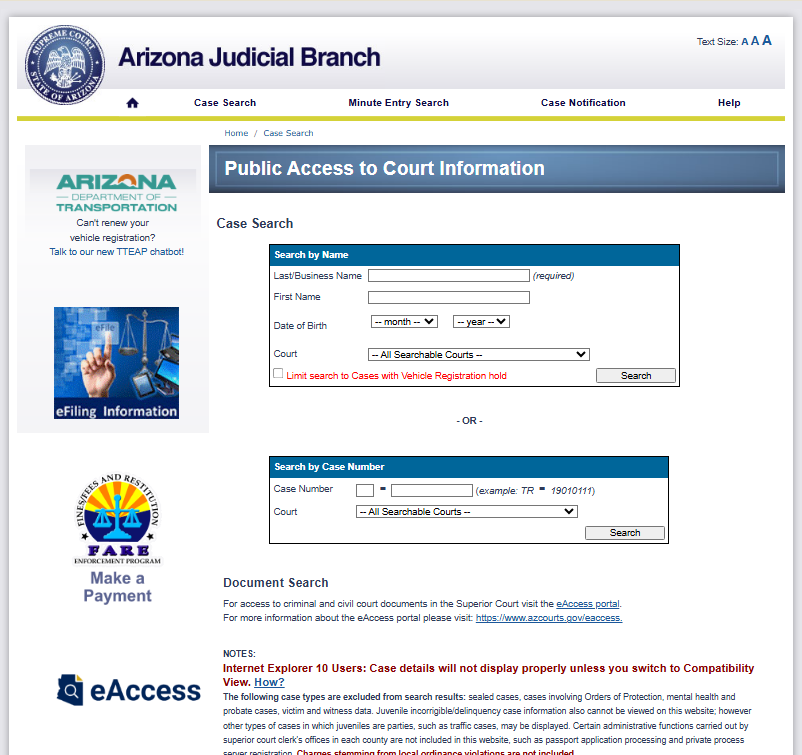
- Visit the Pinal County Superior Court’s Case Search Portal: https://apps.azcourts.gov/publicaccess/caselookup.aspx
- Search by Name
- Open the case lookup link.
- Enter the last or business name.
- Add the first name (optional).
- Select a court or keep All Courts.
- Click Search.
- Search by Case Number
- Open the same case lookup page.
- Enter the case number.
- Choose a court (optional).
- Click Search.
Viewing Dockets & Case Updates
- Court dockets are updated regularly to reflect hearings, motions, and judgments.
- Online systems allow users to track ongoing cases and print summaries for personal reference.
- Access is generally limited to documents that are not confidential or sealed.
Court Jurisdiction & Judicial Authority
The Pinal County Superior Court holds general jurisdiction over civil, criminal, family, probate, and juvenile cases. It serves as the main trial court, handling matters beyond the scope of lower courts like Justice and Municipal courts.
General Jurisdiction vs Lower Courts
The Superior Court has broader authority than lower courts, which include Justice Courts and Municipal Courts. While lower courts handle minor criminal offenses, traffic violations, small claims, and preliminary hearings, the Superior Court addresses more serious matters that require full trial procedures and judicial oversight.
Key distinctions:
| Court Type | Typical Cases | Authority |
|---|---|---|
| Justice Court | Traffic violations, misdemeanors, small claims (up to $10,000), preliminary hearings | Limited jurisdiction within its precinct |
| Municipal Court | City ordinance violations, minor criminal offenses | City-level authority only |
| Superior Court | Felonies, large civil disputes, family law, probate, juvenile matters | General jurisdiction across Pinal County |
This structure ensures cases are heard in the proper court based on severity and legal requirements.
Types of Cases Handled by the Superior Court
The Pinal County Superior Court manages a wide variety of legal matters. Its authority covers:
Civil Cases
Civil matters include disputes over contracts, personal injury, property, and business issues. These cases often involve higher financial stakes and require formal court procedures, including jury trials when applicable.
Criminal Cases
The court handles serious criminal offenses, including felonies, complex investigations, and appeals from lower courts. Criminal proceedings involve prosecutors, defense attorneys, and judges who oversee trials, sentencing, and appeals.
Family Law
Family-related matters such as divorce, child custody, child support, and domestic violence injunctions are addressed in the Superior Court. Judges evaluate evidence, ensure legal protections, and make rulings in the best interest of affected parties.
Probate
Probate cases deal with estates, wills, guardianships, and trusts. The court supervises the distribution of assets, validates legal documents, and resolves disputes among heirs or beneficiaries.
Juvenile Matters
Juvenile cases, including delinquency, dependency, and child protection, fall under the court’s authority. Judges focus on rehabilitation, legal accountability, and the welfare of minors.
Difference Between Superior and Justice Court Jurisdiction
The key distinction lies in scope and case complexity:
- Justice Courts handle smaller civil disputes and less severe criminal offenses.
- Superior Court has authority over all felony cases, high-value civil disputes, family law, probate, and juvenile matters.
This ensures that serious cases receive the appropriate level of judicial scrutiny and resources.
Connection to State Courts
As a trial court of general jurisdiction, the Pinal County Superior Court operates within Arizona’s state court system. It follows state statutes, rules of civil and criminal procedure, and appellate oversight from the Arizona Court of Appeals and Supreme Court when necessary.
Key terms to note:
- Case Jurisdiction: The authority of a court to hear a particular case.
- Judicial Authority: The legal power granted to a court to make decisions and enforce laws.
- Trial Court: A court where cases are initially filed, evidence is presented, and judgments are made.
Divisions of the Court & What They Do
The Pinal County Superior Court is organized into specialized divisions to handle different types of cases efficiently, including Civil, Criminal, Family, Probate, and Juvenile Courts. Each division focuses on specific legal proceedings to ensure fair and orderly resolution of disputes. For individuals looking to track the progress of a particular matter, the court provides a Case Lookup tool that allows users to search for case information quickly and conveniently. This feature helps parties, attorneys, and the public stay informed about ongoing cases across all divisions.
Civil Division
The Civil Division handles disputes between individuals, businesses, or government entities involving money, contracts, or property. This includes cases like contract disagreements, property issues, personal injury claims, and civil harassment petitions. Procedures typically begin with filing a complaint, followed by hearings and, if needed, a trial where judges review evidence, hear testimony, and issue legally binding rulings.
Criminal Division
The Criminal Division oversees cases involving alleged violations of state law, ranging from misdemeanors to serious felonies. It manages offenses such as theft, assault, DUI, and drug crimes, guiding cases through arraignments, pretrial hearings, trials, and sentencing. Prosecutors represent the state, while defense attorneys protect the rights of defendants, ensuring that legal proceedings remain fair and transparent.
Family Court
Family Court addresses legal matters affecting families and domestic relationships, including divorce, child custody, child and spousal support, and domestic violence orders. The division often encourages mediation and negotiation before formal trials, and judges have the authority to issue binding orders to protect children’s welfare and support equitable resolutions among family members.
Probate Court
Probate Court manages matters related to wills, estates, and guardianships, ensuring proper distribution of assets and protection of beneficiaries. It handles estate administration, validates wills, resolves inheritance disputes, and appoints guardians for minors or incapacitated adults. Judges review documents, supervise executors, and oversee procedures to maintain legal order and compliance with state law.
Juvenile Court
Juvenile Court focuses on cases involving minors under 18, emphasizing rehabilitation and guidance rather than punishment. Typical cases include delinquency, truancy, abuse or neglect, and probation supervision. The court provides counseling, educational programs, and monitored placements, with judges handling hearings and probation agreements to help youth achieve positive outcomes while safeguarding public safety.
Judges & Judicial Officers
The Pinal County Superior Court is led by a Presiding Judge, who oversees court administration and ensures cases proceed efficiently. Other judges and judicial officers handle civil, criminal, and family matters, each exercising significant judicial authority within the county.
Presiding Judge: Leadership and Oversight
The Presiding Judge serves as the chief judicial officer of the Superior Court. This judge manages the court’s schedule, supervises judicial staff, and coordinates with other branches of government. By setting administrative priorities, the Presiding Judge ensures the court operates fairly and efficiently for the public.
- Oversees case assignments for all judges
- Supervises court personnel and operations
- Maintains consistency in judicial procedures
- Represents the court in county and state matters
The role demands not only experience in the law but also leadership skills to maintain smooth court operations. The Presiding Judge’s decisions can influence how cases move through the system and how judicial resources are allocated.
Judges and Their Responsibilities
Pinal County Superior Court has multiple judges, each with specialized responsibilities. They preside over cases ranging from civil disputes and probate matters to criminal trials and family law. Every judge holds full judicial authority to interpret laws, issue rulings, and manage courtroom proceedings.
Key judicial roles include:
- Civil Judges – handle contracts, personal injury, and business disputes
- Criminal Judges – preside over felony and misdemeanor cases, sentencing, and appeals
- Family Court Judges – address divorce, child custody, and domestic relations
- Probate Judges – manage wills, estates, and guardianship cases
Each judge applies state laws and county rules while ensuring fairness and impartiality. Their decisions impact residents, local policies, and the interpretation of Arizona law within Pinal County.
Judicial Officers and Support Staff
Alongside judges, the court employs judicial officers such as commissioners and magistrates. These officers often handle preliminary matters, hearings, and administrative functions to streamline case processing. They work closely with the Presiding Judge and the court’s administrative team to maintain consistency and uphold judicial authority across all proceedings.
Roles include:
- Hearing officers for family and civil matters
- Magistrates oversee traffic and minor criminal cases
- Court commissioners assisting with procedural rulings
Together, judges and judicial officers ensure that the Pinal County Superior Court delivers justice efficiently, transparently, and in line with Arizona law.
Filing a Case & Court Procedures
Filing a case at the Pinal County Superior Court starts with identifying whether it is civil, criminal, family, or probate, and completing the appropriate forms. Each type follows specific steps for submission, required fees, and scheduled hearings. Proper documentation and careful attention to details help cases progress smoothly through the court system.
How to File a Case
The first step is determining the case type: civil cases involve disputes over contracts, property, or damages, criminal cases involve legal charges, family matters include divorce or custody, and probate covers wills or estates. The correct forms must be completed, available at the courthouse or online, and filing fees range from $100 to $40,0 depending on the case. Once forms are submitted with fees, copies should be retained for reference, ensuring all information is accurate and complete.
Court Procedures After Filing
After filing, cases move through hearings, pretrial processes, and trial phases. Criminal cases begin with an arraignment for entering a plea, while civil, family, and probate cases often have initial hearings to review documents and set schedules. Evidence is exchanged during discovery, motions are filed, and trials include statements, witness testimony, and a verdict. Post-trial, the court issues judgments, and appeals may be filed if necessary.
Tips for a Smooth Filing Process
Accuracy in forms, organized supporting documents, and keeping copies of all submissions are critical. Monitoring deadlines for motions, responses, and hearings helps avoid delays, and understanding trial phases ensures smoother case management. Using proper forms and following court procedures can make the filing and hearing experience more efficient for all case types.
Appeals & Appellate Review in Pinal Superior
Appeals in Pinal County Superior Court provide a formal path for challenging decisions from Justice Courts or lower jurisdictions. The court reviews these cases to determine whether legal errors affected the original outcome.
How Appeals Work
When a party is dissatisfied with a lower court decision, they may appeal to the Superior Court. The process begins by filing a Notice of Appeal within the deadline set by Arizona law, usually within 30 days of the judgment. The Superior Court does not hold a new trial for all cases; instead, it focuses on errors of law or procedure made in the lower court.
Key points about the appellate process:
- Filing Requirements: The appellant must submit a notice and often pay a filing fee.
- Record on Appeal: The court reviews the trial record, including transcripts, evidence, and filings.
- Written Briefs: Both parties submit briefs arguing why the decision should be upheld or reversed.
- Oral Argument: In some cases, attorneys present arguments before the judge.
Timelines and Rules
The timeline for an appeal depends on the case type and complexity. Civil appeals may take several months, while criminal appeals can take longer.
- Initial Filing: Within 30 days for most civil or criminal cases.
- Briefs Submission: Typically within 20–40 days after filing.
- Court Review: The judge examines the case record and arguments.
- Decision: The court issues a written decision, either affirming, reversing, or remanding the case.
The Pinal County Superior Court follows the Arizona Rules of Civil Procedure and Rules of Appellate Procedure, ensuring fairness and consistency. Parties must meet deadlines and provide all required documents to prevent delays.
What to Expect
Appellants should expect a focus on legal reasoning rather than new evidence. The process is formal but structured, and the court aims to ensure lower court decisions comply with state law.
Common outcomes include:
- Affirming the original decision
- Reversing the judgment
- Remanding for further proceedings
The appellate process helps parties prepare accurate filings and comply with deadlines. Legal representation is often recommended, as procedural errors can affect the outcome.
Jury Duty & Public Participation
Jury duty is an opportunity for residents to participate in the judicial process of the Pinal County Superior Court. Citizens receive notices and serve in trial courts to ensure fair proceedings.
Jury service usually begins with a mailed summons listing the reporting date and instructions. Key points include:
- Eligibility
- Must be a U.S. citizen, resident of Pinal County, and at least 18 years old.
- Individuals with felony convictions may be restricted.
- Selection Process
- Randomly selected from voter registration and driver license lists.
- Potential jurors complete questionnaires and may be interviewed during voir dire.
- During Service
- Jurors hear evidence, follow court instructions, and deliberate to reach verdicts.
- Compensation includes daily pay and reimbursement for mileage.
- Public Participation
- Observers may attend open trials but must follow courtroom rules.
- Citizens can also engage in civic programs or volunteer for court-related services.
Serving on a jury ensures community involvement in legal decisions and supports the trial court’s mission of fair justice.
Court Locations & Contact
The Pinal County Superior Court serves residents through its main courthouse in Florence, AZ, and satellite offices in Casa Grande, Apache Junction, and San Manuel. Each location provides essential judicial services and easy access for filings and hearings.
Main Courthouse – Florence, AZ
Address & Contact:
- 971 Jason Lopez Circle, Florence, AZ 85132
- Phone: (520) 866-5000
- Email: superiorcourt@pinalcountyaz.gov
Hours & Parking:
- Monday – Friday, 8:00 AM – 5:00 PM
- Public and accessible parking is available on-site
Directions: Near Butte Avenue and Jason Lopez Circle. GPS: 33.0361° N, 111.4146° W
The Florence courthouse handles civil, criminal, family, probate, and juvenile cases. Courtroom access is available for public hearings, and administrative offices are on the ground floor.
Satellite Offices
Casa Grande Division
- 520 E. Florence Blvd, Casa Grande, AZ 85122
- Phone: (520) 836-3400
- Hours: Mon–Fri, 8:00 AM – 5:00 PM
- Handles local civil and criminal filings and hearings
Apache Junction Division
- 575 N. Idaho Rd, Apache Junction, AZ 85119
- Phone: (480) 982-5700
- Hours: Mon–Fri, 8:00 AM – 5:00 PM
- Manages limited civil and family cases
San Manuel Division
- 108 N. Highway 77, San Manuel, AZ 85631
- Phone: (520) 385-2211
- Hours: Mon–Fri, 8:00 AM – 4:30 PM
- Handles minor civil disputes and community hearings
FAQs – About Superior Court
The Pinal County Superior Court handles a wide range of legal matters, from serious criminal cases to family and probate issues. Below are answers to some of the most common questions about how this court operates and what it handles.
What types of cases does the Pinal County Superior Court hear?
The Pinal County Superior Court handles serious criminal cases, civil disputes, family matters, probate issues, and juvenile cases. It hears felony offenses, lawsuits involving larger sums, divorces, child custody matters, adoptions, wills, estates, and cases concerning minors. This court also reviews appeals from lower courts, ensuring that complex or high-stakes legal matters are managed with thorough judicial attention.
How does Superior Court differ from Justice Court?
Superior Court manages major legal cases, while Justice Court focuses on minor criminal offenses, traffic violations, and small civil claims. Superior Court deals with higher monetary disputes and more serious crimes, and it also reviews appeals from Justice Court decisions. This distinction ensures that significant legal matters receive a more detailed review and judicial oversight, while lower-level issues are resolved efficiently at the Justice Court level.
What is the role of the Presiding Judge?
The Presiding Judge leads the Superior Court by overseeing case management, supervising court staff, and ensuring procedures comply with state law. This judge assigns cases to other judges, sets court policies, manages dockets, and maintains the efficient operation of the court. Their role is essential for upholding fairness, consistency, and timely handling of all legal matters within the Superior Court.
How do I file an appeal?
To file an appeal from the Superior Court, one must submit a notice of appeal, usually within 30 days of the court’s decision, to the clerk of the court. The appellant’s record, including transcripts, exhibits, and relevant documents, is then prepared and submitted to the appellate court. Both parties provide written briefs, and the appellate judges review the legal arguments, sometimes holding oral hearings, before issuing a decision that may affirm, reverse, or remand the case for further proceedings.
How can I check the status of my case at Pinal County Superior Court?
Anyone involved in a case can check its status by visiting the Pinal County Superior Court online case search or contacting the court clerk directly. The case information includes scheduled hearings, filings, and decisions. Staying informed about your case ensures deadlines are met and allows parties to prepare for upcoming court dates efficiently.